Using machines to design biomaterials

AIMS, at the School of Physics, Suranaree University of Technology, combines artificial intelligence with first-principles modeling to discover, understand and predict new materials.

Where physics meets data

AIMS is built on computational condensed matter physics: density functional theory (DFT) calculations of real materials, checked against X-ray absorption, infrared, photoemission and other experiments. Machine learning sits on top of that foundation. It makes the physics faster and reaches problems that physics alone cannot.

DFT and first principles

Electronic structure, band gap engineering and defect formation energies with VASP and Quantum ESPRESSO.

Spectroscopy simulation

XAS, XPS and IR spectra that fingerprint local structure and validate experimental data.

Applied AI and ML

Materials discovery, phase identification and image analysis for medical and agricultural problems.

0research themes in two tracks
0forecast issuances benchmarked in one study
0models compared head to head
0half-hour steps forecast (24 h ahead) per prediction

Collaborators: NANOTEC (NSTDA), Thai Synchrotron National Lab, Tohoku University, KAIST, UC Berkeley, Case Western Reserve University and the Institute for Basic Science. We are looking for partners in experimental physics, chemistry, materials engineering and medical research.
Research

Two tracks, one method: physics-based models for understanding, machine learning for speed.

Condensed matter physics and DFT

The foundation of the group. First-principles calculations of defects, interfaces, surfaces and layered materials, always tied back to a measurement.

01

Defects in oxides

Where is the hydrogen, manganese or calcium atom, and what is it doing? We compute vibrational modes and X-ray absorption spectra for candidate defect sites and match them to infrared and XANES measurements in SrTiO3, BaTiO3 and CdTe.

SrTiO3BaTiO3IRXANES
02

Interfaces and surfaces

Strain, intermixing and the two-dimensional electron gas at LaAlO3/SrTiO3, and what core-level binding energy shifts in XPS reveal about the species sitting on a surface.

LAO/STO2DEGXPSMEIS
03

2D materials and photoemission

Band structures of HfSe2 and other layered materials, tuned by strain and alkali-metal dosing, compared directly with angle-resolved photoemission. MXenes and negative electronic compressibility.

HfSe2MXeneARPESStrain
04

Energy materials

Hydrogen storage, lithium-sulfur and lithium-ion batteries, supercapacitors and photocatalysts: how defects, doping and strain change ion diffusion, adsorption and charge transport.

BatteriesHydrogen storagePhotocatalysisV2O5
05

Functional and high-entropy oxides

Electronic, optical and polarization properties of (Ba,Sr,Ca,Bi,Na)TiO3 with VASP, strain effects for piezo-photocatalysis, and elastic properties of materials under pressure.

VASPSQSElasticityHigh pressure
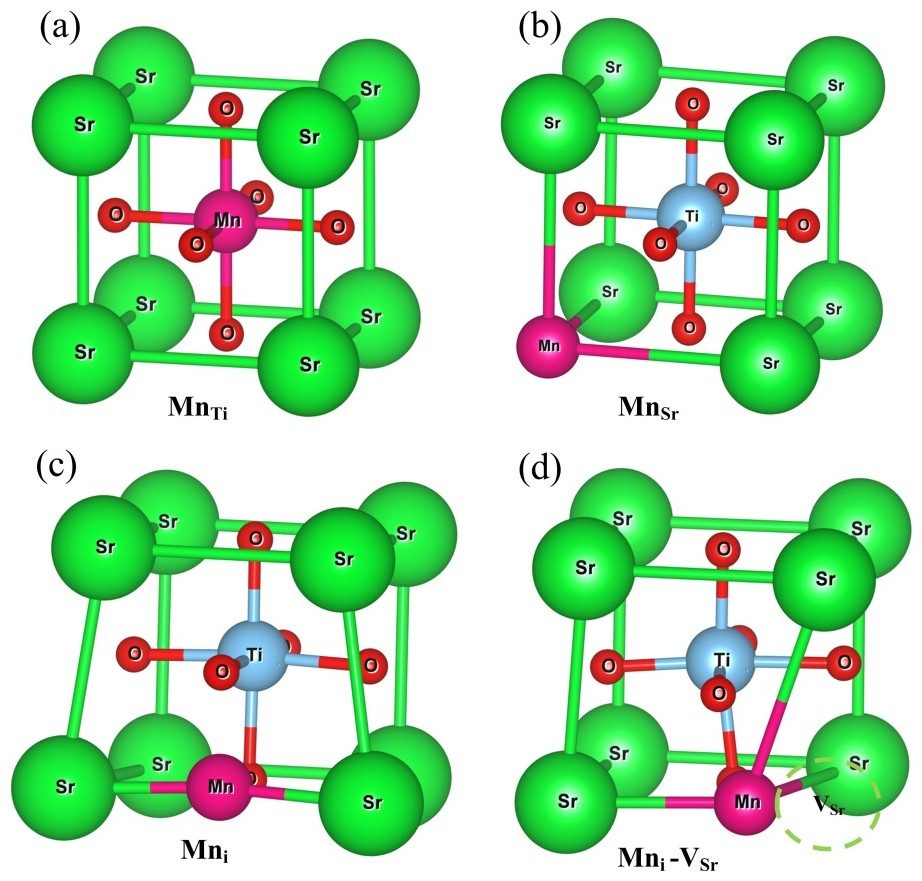
Where does manganese sit in SrTiO3?
Where does manganese sit in SrTiO3?Candidate Mn sites (Ti site, Sr site, interstitial and a complex with a Sr vacancy), compared through XANES. Ceramics International 43, S381 (2017)
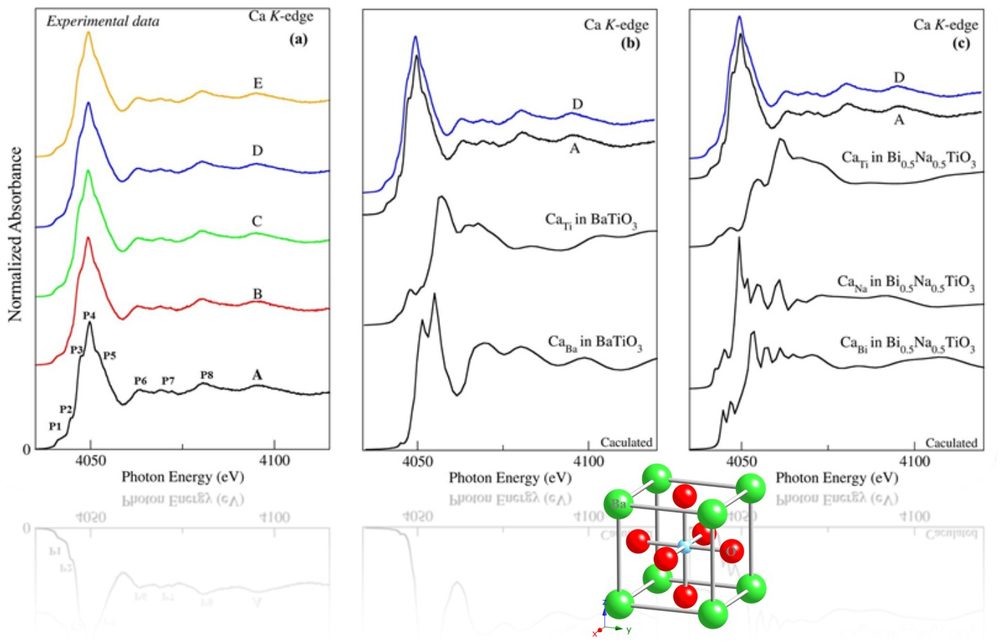
Calcium in BaTiO3 and Bi0.5Na0.5TiO3
Calcium in BaTiO3 and Bi0.5Na0.5TiO3Ca K-edge XANES, measured and calculated, used to decide which lattice site Ca occupies. Philosophical Magazine 95, 3785 (2015)
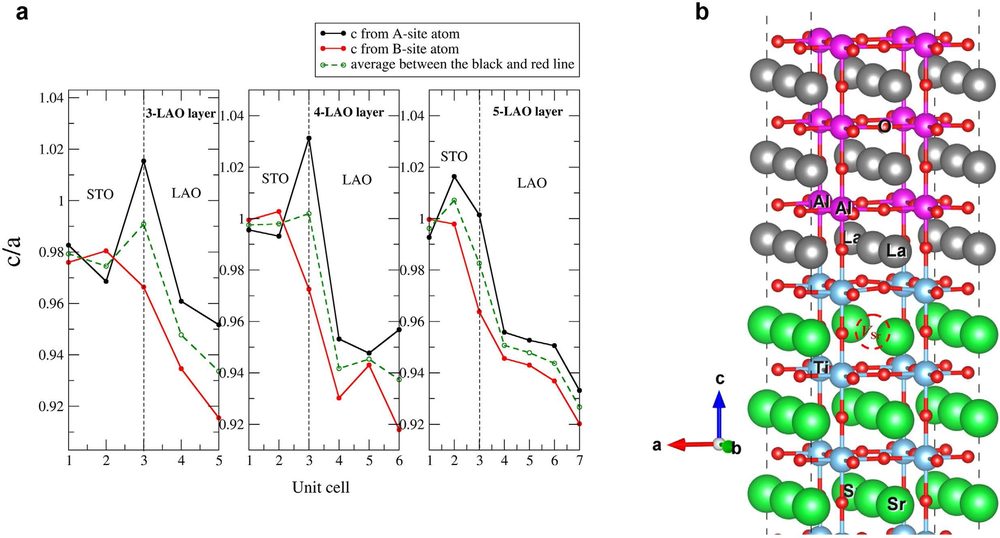
Strain across a LaAlO3/SrTiO3 interface
Strain across a LaAlO3/SrTiO3 interfaceLayer-by-layer c/a ratio from first principles, set against medium-energy ion scattering. Scientific Reports 6, 28118 (2016)
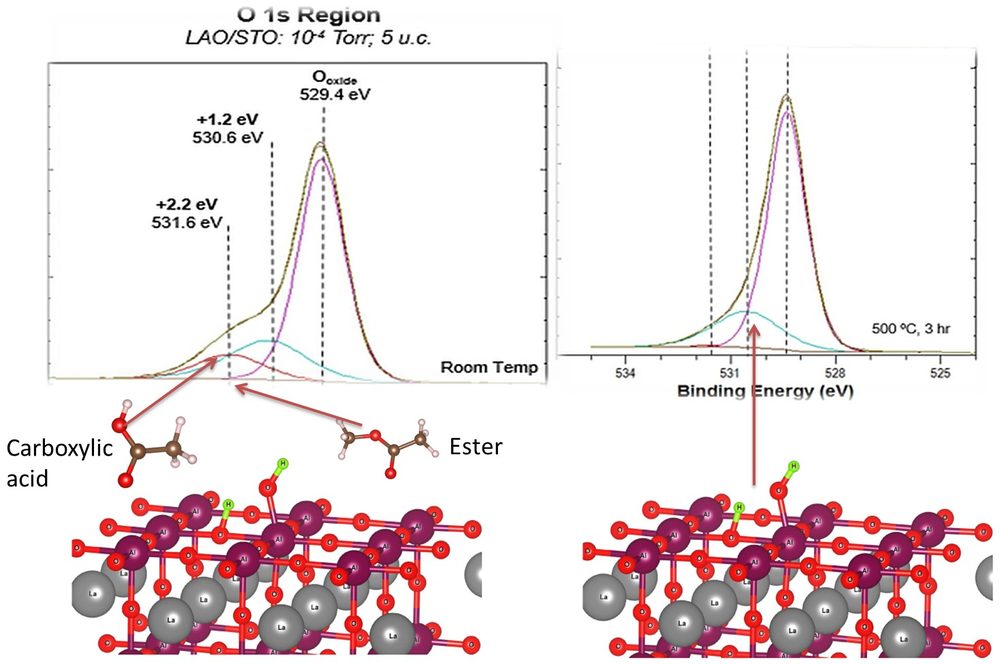
Surface species from core-level shifts
Surface species from core-level shiftsO 1s photoemission on LaAlO3/SrTiO3 with calculated adsorbate models for each peak. J. Electron Spectrosc. Relat. Phenom. 218, 21 (2017)
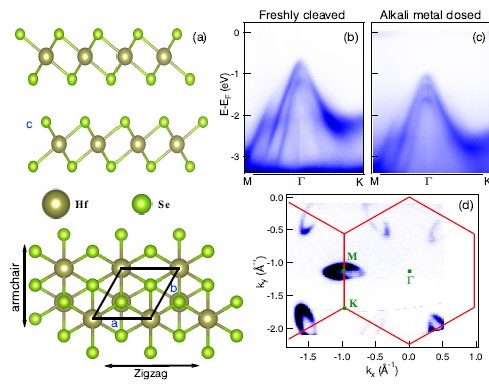
HfSe2 meets alkali metal
HfSe2 meets alkali metalARPES of HfSe2 as cleaved and after alkali-metal dosing, with the layered structure. Physical Review B 94, 201121 (2016)
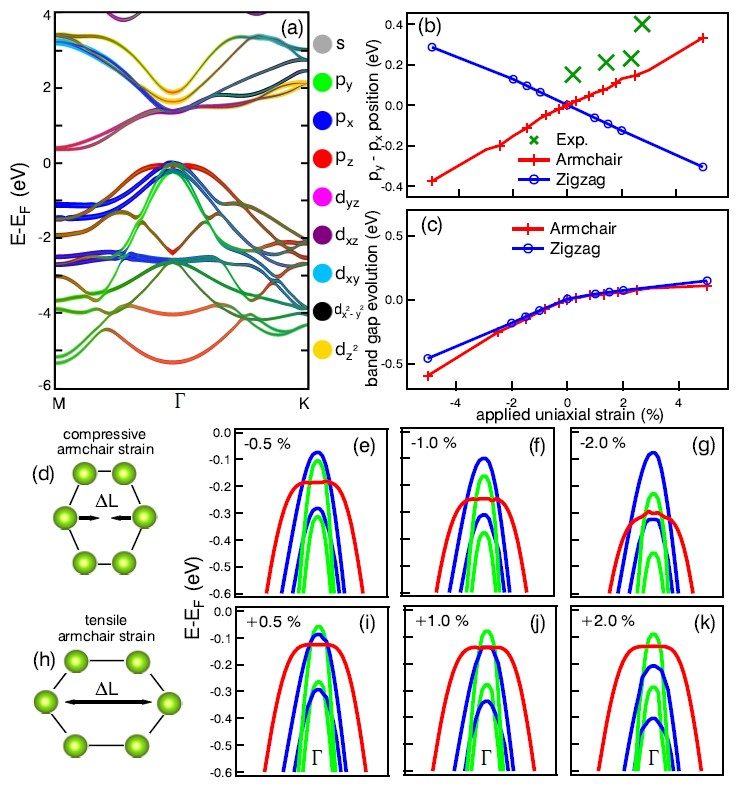
Bands tuned by strain
Bands tuned by strainCalculated bands and valence-band orbital splitting under uniaxial armchair and zigzag strain. Physical Review B 97, 201104 (2018)
A quasi-freestanding MoS2 monolayer
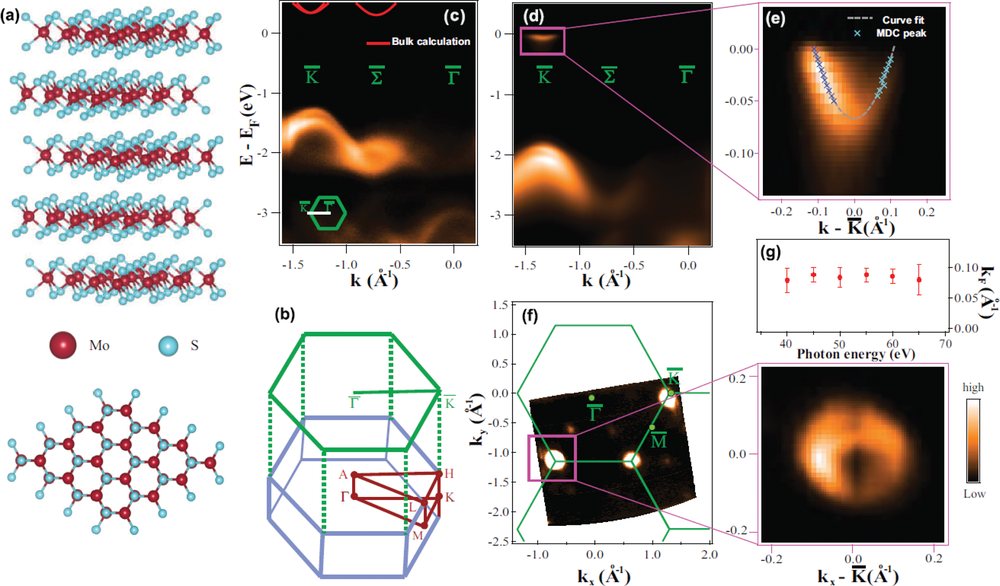
A quasi-freestanding MoS2 monolayerHoneycomb structure and Brillouin zone of MoS2, with ARPES of the pristine and potassium-dosed surface showing electron pockets at K. Nano Letters 14, 1312 (2014)
Potassium on MoS2: adsorbed or intercalated?
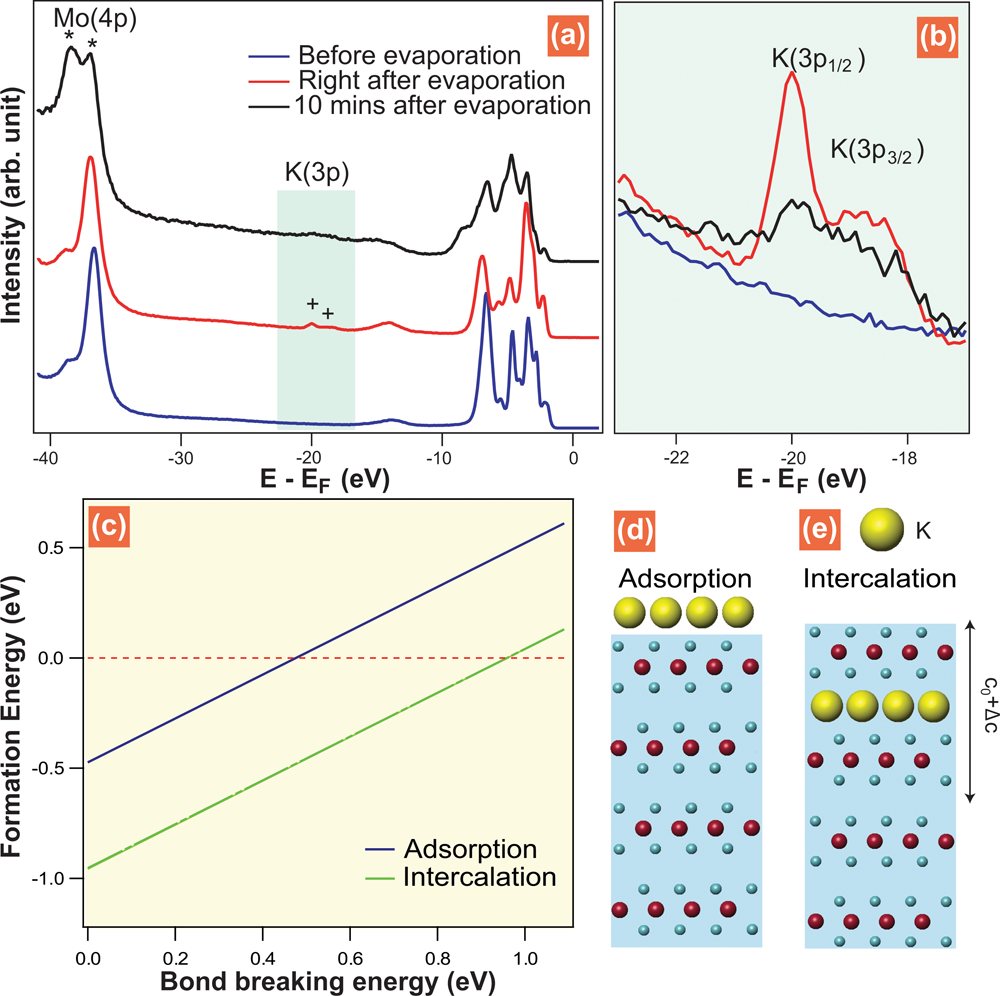
Potassium on MoS2: adsorbed or intercalated?XPS before and after potassium evaporation, with DFT formation energies for adsorption and intercalation. Nano Letters 14, 1312 (2014)

Figures are from our published papers and conference talks. Click a figure to open it full size.

AI for materials and data

Machine learning built on top of that physics: faster spectra, smarter screening, and real-world data problems from medicine to energy markets.

01

Spectra from structure, and back

Neural networks that predict XANES spectra from atomic structure instantly, inverse models that recover structure from XAS with calibrated uncertainty, and automated phase identification from XRD patterns.

XANESXAS inversionXRDUncertainty
02

ML-guided materials screening

Predicting the effect of cationic dopants on hydroxyapatite from large databases, then checking the best candidates against DFT elastic tensors. Neural networks for the mechanical properties of bio-cement.

Explore the HAp dopant database

HydroxyapatiteScreeningDFT validationANN
03

Deep learning for imaging

Diabetic retinopathy classification from fundus images, optical coherence tomography with deep learning for chick gender determination, and real-time pupil tracking for retinal imaging.

CNNOCTMedicalAgriculture
04

Forecasting and data science

Walk-forward benchmarks of gradient boosting and deep models for electricity prices on the Japan Electric Power Exchange, and neural networks for black hole mass in X-ray reverberating AGNs.

LightGBMLSTMJEPXAGN
Atomic structureTrained networkSpectrum
The idea in one picture: a trained network returns a spectrum for a given structure instantly, so thousands of candidates can be screened before any beamtime is booked.

Learn to compute at scale

Our DFT and machine-learning work runs on high-performance computing (HPC) clusters. Students learn to use them well, a skill that carries into academic research and into industry careers in computational science and data science.

0CPU cores on the group's cluster at SUT
P100a GPU node with 16 CPU cores and one NVIDIA Tesla P100 GPU
LANTAproject allocations on the LANTA supercomputer, for jobs that outgrow our own machines
Energies, spectra Train ML models Job scriptScheduler queueCompute nodes in parallelResults
  1. Work on a Linux cluster. Shell, file systems, modules, remote editing and sharing data safely.
  2. Submit and manage batch jobs. Write job scripts, use the scheduler queue, monitor runs and recover failed ones.
  3. Run DFT in parallel. VASP and Quantum ESPRESSO across many cores, with convergence tests and scaling checks before a big run.
  4. Automate workflows. Python scripts that build structures, launch many calculations and parse the results.
  5. Turn results into models. Collect the calculated data and train machine-learning models on it.

Funding for students

Several kinds of support are available to students who join the group. Availability, amounts and deadlines change each year, so contact us before you apply.

01

RU Advance Nano

Support from the Research Unit (RU) on Advance Nano at Suranaree University of Technology, available to students working with the group.

SUTResearch Unit
02

OROG scholarship

A scholarship for graduate students (master's or PhD) who do their thesis with a SUT faculty member holding research funding from an external source.

SUTMaster'sPhD
03

Fundamental Fund projects

Student support paid from Fundamental Fund research projects run in the group.

Project-funded
04

Full-time researcher positions

Paid research positions for graduates who already hold a master's or PhD degree.

Master's graduatesPhD graduates
05

Industry and other projects

Funding from industry projects and other sources, for people who want to work on applied problems with partners.

IndustryApplied research

Not sure which one fits your situation?

Ask about funding

Publications

Recent and in preparation

2026

A 48-Step Walk-Forward Benchmark of Tree-Based and Deep Learning Models for Day-Ahead and Imbalance Price Forecasting in the Japan Electric Power Exchange

P. Sriboriboon, I. Fongkaew

2026

Machine-learning screening of cationic dopants in hydroxyapatite: cross-domain predictions tested against DFT elastic tensors

N. Pandech, L. Ngamwongwan, S. Jungthawan, W. Sailuam, I. Fongkaew. 7th Sino-Thai Symposium on High Energy Physics, Astrophysics, Materials Science and Beyond

2026

Electronic, Optical, and Polarization Properties of High-Entropy Perovskite Oxide (Ba0.2Sr0.2Ca0.2Bi0.2Na0.2)TiO3

L. Liu. Stage 1 report, School of Physics, SUT

All papers

Source: Google Scholar profiles of Ittipon Fongkaew and Sirichok Jungthawan, merged and de-duplicated by title, November 2026.

Meet the team

Group leaders

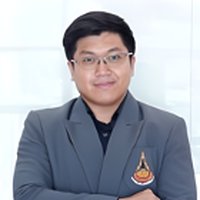
Sirichok JungthawanSirichok Jungthawan
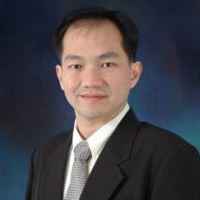
Ittipon FongkaewIttipon Fongkaew

Distinguished professors who support our research

Prof. Dr. Sukit LimpijumnongProf. Dr. Sukit LimpijumnongDistinguished Professor
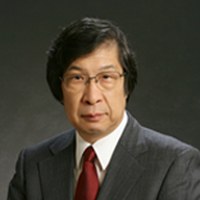
Prof. Dr. Yoshiyuki KawazoeProf. Dr. Yoshiyuki KawazoeDistinguished Professor
Prof. Young-Hoon KiemProf. Young-Hoon KiemDistinguished Professor

Postdoctoral researchers

Keerati KeeratikarnKeerati Keeratikarn
Panithan SriboriboonPanithan Sriboriboon

Graduate students

Xingji TangXingji Tang
Longxun LiuLongxun Liu
Ratsadakorn Yimsabai ManeewongRatsadakorn Yimsabai Maneewong

Interested in joining AIMS?

We welcome undergraduate, master's and PhD students curious about physics, programming and machine learning.

Get in touch

ittipon@g.sut.ac.th  ·  sirichok@g.sut.ac.th